On the road (again)

Seems like I’m hardly ever at home anymore.
On the ferry between Helsingborg and Helsingør.

Seems like I’m hardly ever at home anymore.
On the ferry between Helsingborg and Helsingør.
Sometimes you wonder have things have turned out for a person.
I was going through some old files and ran across a collection that I had used for an exhibit at Scandinavian Photo a few years back, 2005, I think. Most of the pictures in the exhibit were recent, but I added a few from years back, for reasons I don’t really remember.
It was probably the same thing. What happened to this little boy?

St. Louis county had deemed the apartment he lived in to be unfit. They wanted to take him away from the mother. The reason? Lead paint falling off the walls. There was a risk he would eat the flakes and get poisoned.

The woman in the first picture is his grandmother, in the second, his mother. His grandmother was offering to take him in to live with her.
I don’t know how it ended.
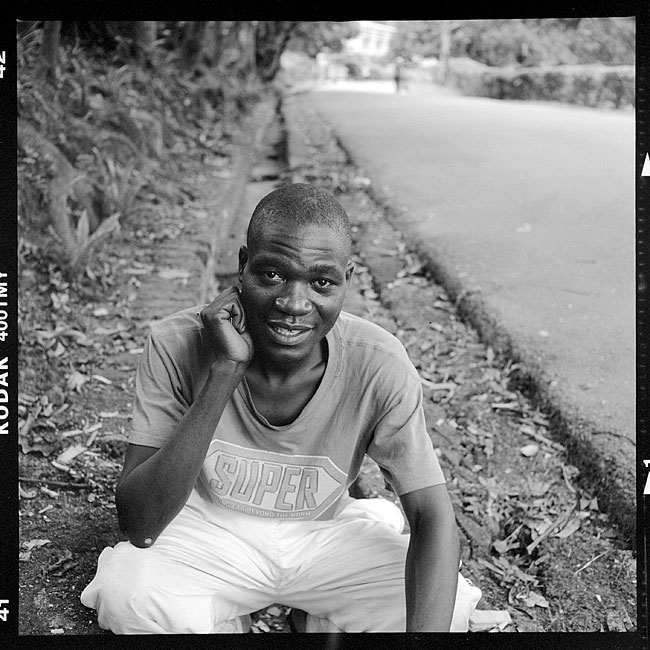
One of these days I will gather the strength to write an in depth report of the on-going story of my contact with Philip Tambala and the aftermath. I write “aftermath” because he has died. There’s a story there too.

From the same ditch where we were sitting:

In Africa there is not the same incentive to automate or to create efficient work-flows. There are so many people looking for work.
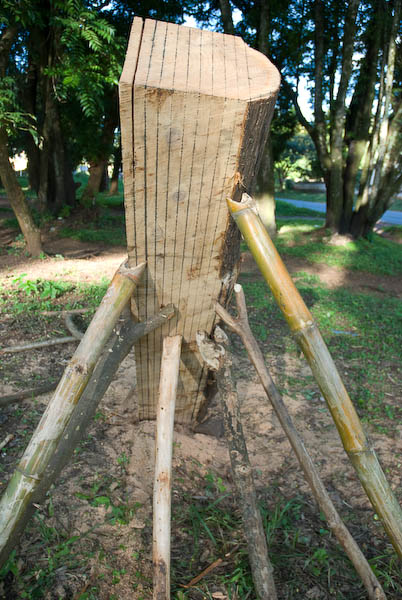
I passed by these men working in the stream in Zomba (Malawi). They had already felled large gum trees (Eucalyptus) and were breaking the trunks down into small pieces; not small pieces, just smaller.
These pieces of timber were then taken up on land, propped up, lines are traced and then they manually, using the same technique of two workers on one saw, cut out planks from the smaller pieces of tree trunks.

A closer look:

The next stage, on land:

There’s a family I’ve been involved with for a couple of years now in Malawi. The father, Philip, died a few months ago. If you dig around on my blog or ask me, I can point to some background information.
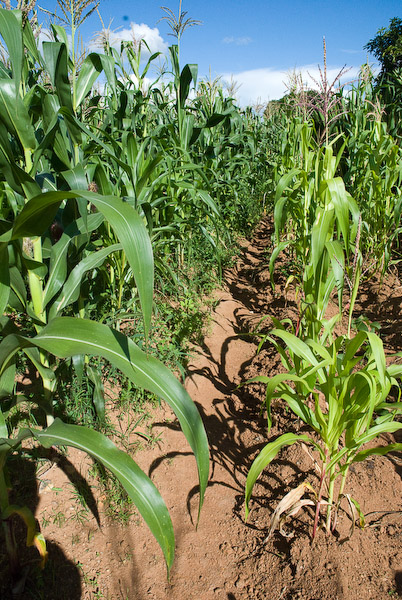
This year the priority is food. It always is in Malawi. The price of fertilizer has gone up almost 3 times from last year and cost around 90 USD a bag. That is a total insult to the masses of farmers out in the country who rarely see cash. The majority has never seen 90 USD at one time. It takes about 8 bags to cover a field large enough to supply a family with food.
You can see the difference. The corn (maize) on the left is a field that belongs to the family I am helping. The corn to the right, to someone else in the hamlet who couldn’t afford fertilizer:

Dorte said one thing to me in English: “blankets”. And this is when she said it:

The cold season is coming and sleeping on the earth can be very, very cold.
There’s some more pictures here:
This is my contribution to the LUG (Leica Users’ Group) print exchange, January 2009. I chose this particular shot, over 30 years old, in order to compare the results from an Epson Stylus PRO 3800 with an old print I made in the darkroom on Agfa Portriga Rapid, selenium toned. That particular combination has been what I have been working towards every since the paper disappeared from the market.

The picture was taken on one of my bus-rides back and forth to work when I worked on the south side (scrubbing Dutch) of St. Louis. This shot was taken in downtown St. Louis where I changed buses.
Nikon SP, 50 Nikkor, Ilford HP4
I was pleased with the results from the Epson. I’m just starting to get the hang of it, but there’s no doubt in my mind that it will work out. Finally! (I hate the darkroom). After scanning the negative with a Nikon LS-5000, all work, adjustments, spotting etc, and printing, was done in Lightroom.
The autmn and early winter are characterized by short, usually drab, days. Now and then a sliver of light will peek through and that has been the theme this week and the next couple of weeks.

Ljus, det är det som attraherar mig. Vi har inte mycket av den varan nu på vintern, men det är så vackert när den strålar igenom.
Den här forsen har försett Kvarnby (Mölndal) med kraft sedan 1600-talet. Vattnet faller brant från Mölndals övre ner till centrum.

Sett nedanifrån:

Och från sidan:

Längst ner finns Kråkan, en gammal restaurang:

Återigen, det finns mer i skokartongen.
Samma utrustning som förra veckan, fast Fomapan 200 istället för Fomapan 400.
powered by wordpress | theme by tony street dot com